
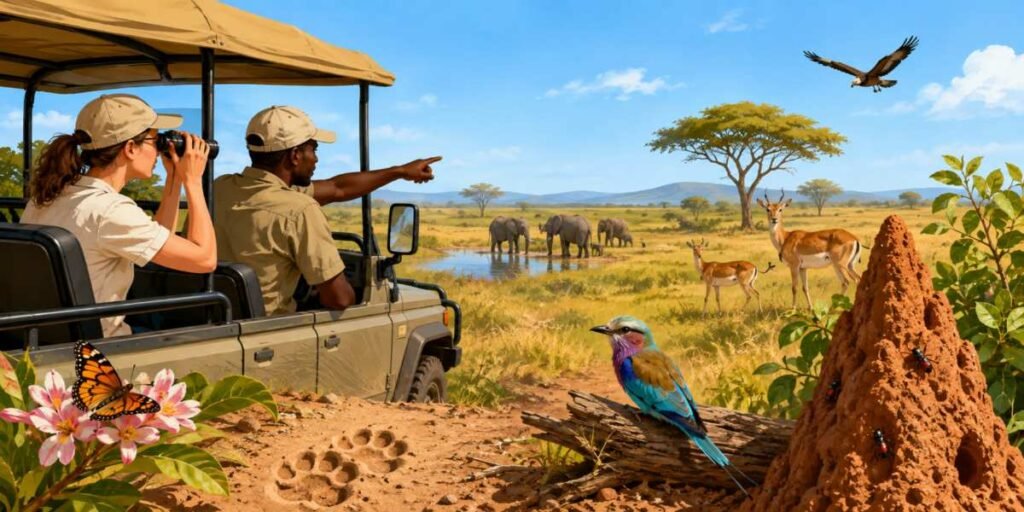
That apparent emptiness is deceptive. A safari is taking place whether a lion has conveniently positioned itself beside the vehicle or not. Birds are warning one another, insects are working, herbivores are monitoring distant threats and fresh tracks may reveal that an animal passed through only minutes earlier. The trick is learning to notice a world that does not always arrive with horns, tusks or an excellent profile for photographs.
Stop Waiting for the Main Event
First-time safari travellers can understandably develop a mental checklist. Elephant: done. Giraffe: done. Lion: still required. Leopard: increasingly becoming a personal grievance.There is nothing wrong with wanting to see the famous animals. They are famous for good reason. The problem begins when everything between those sightings is treated as dead time. Looking continuously towards the horizon for something large can mean overlooking dozens of smaller events happening within a few metres of the vehicle.
Try occasionally changing the question from “Where are the animals?” to “What is happening here?” That small adjustment encourages observation rather than expectation. Watch how antelope position themselves. Notice whether several animals suddenly look in the same direction. Listen when the general background noise changes. Wildlife frequently provides clues about what is nearby long before human eyes find it.
Learn to Read the Ground
Tracks turn an apparently uneventful road into a record of recent activity. Even without becoming an expert tracker, travellers can learn to distinguish a few common footprints and recognise the difference between an old mark and one that looks unusually fresh.Guides may also point out dung, disturbed vegetation, scratch marks or places where an animal has rested. None provides the instant satisfaction of discovering a leopard draped photogenically over a branch, but together they reveal how much activity occurs beyond human sight.
Tracking also introduces uncertainty, which is part of what makes wildlife observation interesting. Fresh prints do not guarantee that their owner is waiting politely around the next corner. The animal may be nearby, several kilometres away or apparently enrolled in an advanced course on avoiding tourists.
Listen Before You Look
Sight naturally dominates a safari, but sound can be just as informative. Alarm calls can indicate the presence of a predator. Changes in bird activity may draw attention to something otherwise hidden. At quieter moments, individual calls begin separating themselves from what initially sounded like anonymous background noise.One useful exercise is simply to stop talking for a few minutes and identify how many distinct sounds are audible. Birds may occupy several layers of the landscape, while insects provide a persistent undertone and larger animals occasionally announce themselves from surprisingly far away. Even silence can become noticeable when a previously noisy area suddenly changes character.
The reward is not merely finding more wildlife. Listening changes the pace of the experience itself. Instead of demanding that the landscape produce something spectacular every few minutes, you begin participating in the slower business of discovering what is already there.
Small Creatures Deserve a Promotion
Once attention moves away from the largest animals, the bush becomes considerably more crowded. Beetles, lizards, frogs, butterflies and countless other small creatures occupy spaces that are easily ignored when everyone is scanning for something capable of overturning the vehicle.Birds are particularly good at rescuing quiet periods. Even travellers who arrive with no interest in birdwatching can find themselves becoming suspiciously enthusiastic after a few days. Colour, strange behaviour and wonderfully improbable anatomy have a habit of winning people over. Before long, someone who previously knew “pigeon” and “not a pigeon” may be asking serious questions about hornbills.
Smaller creatures also encourage closer observation. Look at flowers, tree bark, termite mounds and patches of water rather than continually searching the distant horizon. The safari becomes less dependent on rare encounters because there is almost always something worth examining nearby.
Watch What Animals Watch
Animal behaviour can transform an ordinary sighting into something much more revealing. A herd of impala standing beneath a tree may initially seem less exciting than a predator sighting, but watch for several minutes and relationships begin to appear. Some animals feed while others remain alert. Ears rotate towards sounds. Heads rise almost simultaneously. Young animals stay close to adults or test the boundaries of safety.Instead of photographing an animal immediately and mentally moving on, spend time watching what it does next. Ask why it has chosen that position, what it is looking towards and how nearby animals respond to it. Patterns become easier to recognise with practice.
This is particularly valuable around predators. A sleeping lion may appear to have committed itself to an ambitious programme of doing absolutely nothing, but surrounding herbivores may be intensely aware of its location. Their behaviour can tell a parallel story.
Notice How the Landscape Changes
Light, temperature and weather continually alter wildlife activity. Early morning can bring movement after the night, while rising heat may push animals towards shade or water. Later, lengthening shadows change both visibility and behaviour again.Pay attention to these transitions rather than viewing the landscape merely as scenery behind the animals. Notice where shade falls, which areas retain water and how vegetation changes between open ground and woodland. Understanding habitat helps explain why particular species appear where they do.
Photography benefits too. Dramatic animals are wonderful subjects, but changing light across grassland, dust hanging above a track or approaching rain can produce images that capture the character of a safari far better than another tightly cropped photograph of an animal looking vaguely inconvenienced by your presence.
No Lion Around
A richer safari therefore requires surprisingly little specialist knowledge. Ask guides about tracks and calls. Put the camera down occasionally. Look behind the vehicle as well as ahead of it. Spend longer with ordinary species. Most importantly, resist treating every quiet period as a failure to locate something better.Spectacular sightings will remain spectacular. Few people are going to respond to their first wild elephant by announcing that they would rather inspect a beetle. But the memorable quality of a safari often comes from learning that wildlife is not a sequence of headline appearances separated by nothing.
Those supposedly empty hours contain the connective tissue of the experience: sounds, signs, movements, changing conditions and small discoveries that gradually teach you how alive the landscape really is. Once you begin noticing them, waiting for the next lion stops feeling quite so much like waiting.
Article kindly provided by ketsafaris.com