
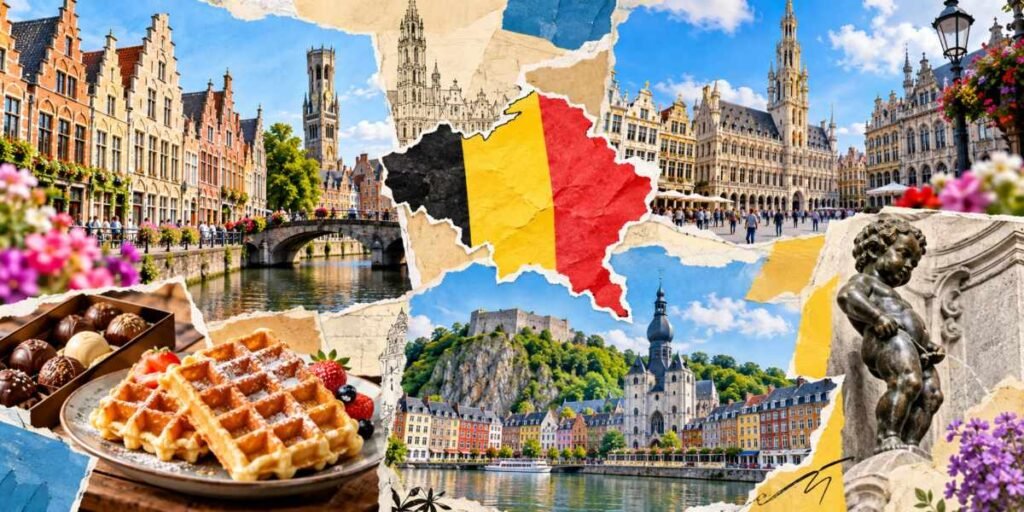
Visitors expecting a miniature version of France or the Netherlands quickly discover something considerably more interesting. Belgium is neither, although both countries have left unmistakable fingerprints on its culture. Understanding these differences transforms a pleasant sightseeing holiday into a fascinating exploration of European history, identity and everyday life.
Three Regions, Several Identities and Quite a Few Governments
Belgium consists of three principal regions: Flanders in the north, Wallonia in the south and the Brussels-Capital Region at its geographical and political crossroads. Each possesses its own distinctive character, shaped by centuries of political change, economic development and linguistic tradition.Flanders is predominantly Dutch-speaking, although the local varieties of Dutch are commonly described as Flemish. Wallonia is primarily French-speaking, with a small German-speaking community in the east. Brussels is officially bilingual in French and Dutch, although French dominates much everyday conversation and numerous other languages reflect its international population.
These distinctions are considerably more than decorative features of regional identity. Belgium has developed an elaborate federal political structure, with responsibilities divided among regional and language-community governments. The resulting system is impressively sophisticated, provided nobody asks for a quick explanation over coffee.
How History Created Belgium’s Cultural Divisions
Modern Belgium became independent in 1830, but its constituent territories had already experienced centuries of shifting political control. Burgundian dukes, Spanish Habsburgs, Austrian rulers, French revolutionaries and Dutch monarchs all influenced the region at different periods.These successive administrations left enduring marks on architecture, religious traditions, commercial relationships and cultural identity. Medieval trading cities such as Bruges and Ghent developed considerable wealth through textiles and international commerce, while parts of southern Belgium later became major centres of coal mining, steel production and heavy industry.
During the nineteenth century, French enjoyed considerable prestige within Belgian government, education and elite society, even where most inhabitants spoke Dutch dialects. The Flemish Movement subsequently campaigned for linguistic recognition and equality, gradually reshaping the country’s political institutions.
Economic fortunes also changed. Wallonia was once Belgium’s industrial powerhouse, while Flanders experienced substantial economic growth during the twentieth century. These developments contributed to regional differences in politics, public attitudes and perceptions of national identity that remain significant today.
When Architecture Tells a Different Story
A journey between Flemish and Walloon cities can reveal contrasting architectural influences, although neither region follows a single uniform style. Flemish historic centres frequently feature stepped gables, ornate guild houses, brick façades and imposing medieval market squares.Walloon destinations such as Namur, Dinant and Liège display their own combinations of stone buildings, riverside fortifications, ecclesiastical architecture and industrial heritage. Local building materials, geography and historical prosperity often explain these differences more convincingly than any simple north-south division.
Brussels adds another dimension, combining grand nineteenth-century boulevards, Art Nouveau masterpieces, European Union offices and buildings whose designers apparently disagreed about which century they were working in.
A Culinary Border Without Passport Control
Belgian cuisine offers another revealing glimpse of regional identity. Although waffles, chocolate, beer and chips enjoy nationwide popularity, local specialities reflect different agricultural traditions, historical influences and attitudes towards eating.Flemish cooking frequently celebrates hearty dishes such as carbonnade flamande, a rich beef stew prepared with beer, and waterzooi, traditionally associated with Ghent. Walloon specialities include boulets à la liégeoise, meatballs served in a distinctive sweet-and-savoury sauce, alongside regional cheeses, cured meats and preparations influenced by neighbouring France.
Even waffles have territorial complications. Brussels waffles are generally rectangular, light and crisp, while Liège waffles are denser, sweeter and enriched with caramelised pearl sugar. Ordering the wrong variety will rarely provoke a diplomatic incident, although describing them as identical might test local patience.
Language Etiquette Can Make All the Difference
For visitors, understanding Belgium’s linguistic geography is particularly useful. In Flanders, beginning a conversation with a friendly ‘goedemorgen’ or ‘dank u’ demonstrates awareness of the local language. In Wallonia, ‘bonjour’ and ‘merci’ are more appropriate starting points.Brussels requires a slightly different approach. Both French and Dutch have official status, although French is widely spoken in shops, restaurants and everyday social situations. English is also common in tourist areas and international workplaces.
Assuming everyone speaks French throughout Belgium can occasionally create unnecessary awkwardness, particularly in Dutch-speaking communities where language carries considerable historical and political significance. English may actually provide a more comfortable common ground when visitors cannot speak the regional language.
The important principle is simple: acknowledge local identity rather than treating Belgium as one linguistically interchangeable destination. A few carefully chosen words can accomplish more than an elaborate explanation delivered confidently in the wrong language.
Different Traditions Behind a Shared Nationality
Regional distinctions extend beyond vocabulary and restaurant menus. Local festivals, folklore, sporting loyalties and community celebrations often reflect identities that existed long before Belgium became an independent state.Carnival traditions in Walloon towns such as Binche differ considerably from the processions, historical pageants and community festivities found in Flemish cities. Regional media and political parties also reinforce distinct cultural conversations, meaning residents of neighbouring communities may follow different television programmes, newspapers and public debates.
Yet these differences coexist with shared institutions, sporting achievements, culinary traditions and national experiences. Belgian identity is neither entirely unified nor simply divided into competing regional camps. Many residents comfortably identify with their city, region and country simultaneously.
Crossing Borders Without Leaving Belgium
Travellers hoping to appreciate these contrasts should consider visiting destinations on both sides of the language boundary rather than concentrating exclusively on Brussels and Bruges. Comparing Ghent with Namur, or Leuven with nearby Walloon communities, reveals how quickly everyday surroundings can change.Allow time for local markets, neighbourhood cafés and smaller museums. Notice the languages used in advertisements, the dishes appearing on menus and the architectural details that distinguish one town from another. Railway journeys make many such comparisons straightforward without requiring a complicated itinerary.
Belgium’s modest geographical dimensions are deceptive. Its remarkable regional variety demonstrates how centuries of history can remain visible in ordinary streets, conversations and customs. Sometimes the most interesting international journey requires travelling only 50 kilometres, and the border exists chiefly in people’s minds.
Article kindly provided by belgiumprivatetours.com