
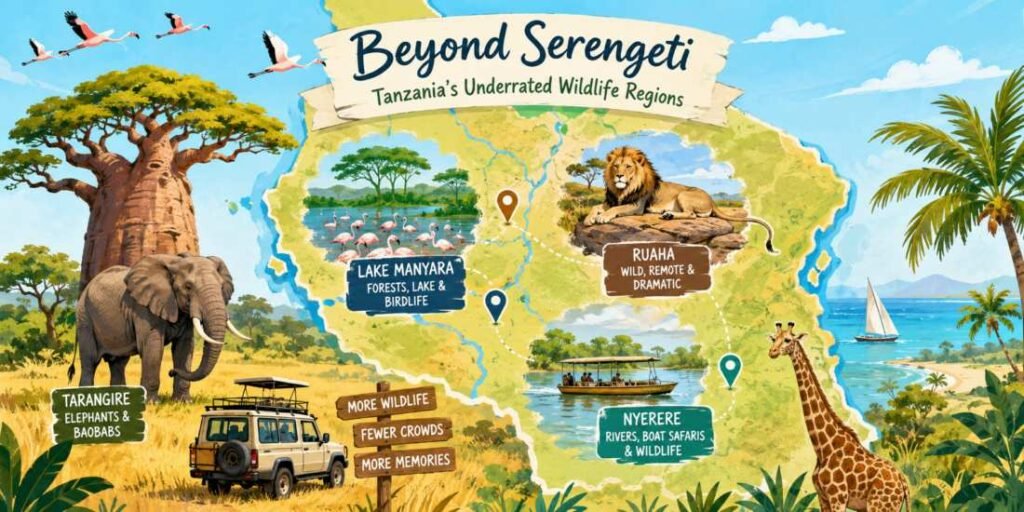
Serengeti gets the spotlight, and fair enough: it has earned its reputation with plains full of drama, dust, hooves, claws, and the occasional zebra looking deeply surprised by life. But Tanzania’s wildlife story is much bigger than one celebrated name. For first-time safari travelers, the best choice is not always the most famous park. It is the place that matches your pace, your curiosity, your budget, and your tolerance for early mornings that begin before coffee has accepted its responsibilities.
Why Look Beyond the Obvious?
Choosing a safari destination by fame alone is a bit like choosing dinner because everyone else ordered the loudest dish. The Serengeti is magnificent, but Tanzania has other regions where wildlife viewing can feel more personal, less crowded, and sometimes more varied in landscape.A first safari can be overwhelming. You are learning how game drives work, how animals behave, how to sit still while something astonishing happens, and how not to drop your binoculars when someone whispers “lion.” Lesser-known regions often give travelers space to absorb the experience without feeling rushed from one headline sighting to another.
Some areas are better for elephants. Some are stronger for birds. Some offer forests, wetlands, baobabs, volcanic scenery, or lakes filled with flamingos that appear to have collectively agreed on a very bold wardrobe. The point is not to avoid famous places. It is to understand that “best” depends on what you actually want to see and feel.
Tarangire for Elephant Lovers and Baobab Fans
Tarangire is often treated as an add-on, which is unfair in the way it is unfair to call the drummer “background noise.” This park has a character all its own. Its great baobab trees look ancient, sculptural, and faintly judgmental, as if they have seen every tourist hat ever invented and remain unimpressed.For first-time travelers, Tarangire is especially rewarding in the dry season, when animals gather around reliable water sources. Elephants are a major draw here, often seen in family groups that reveal complex social behavior. Watching calves learn, adults communicate, and matriarchs lead their herds gives the experience emotional weight without needing anyone to narrate it like a wildlife documentary.
Tarangire also works well for visitors who want strong wildlife viewing without immediately plunging into the longest possible safari route. It can feel wild, scenic, and accessible at the same time, which is not an easy combination to find.
Lake Manyara for Travelers Who Like Surprises
Lake Manyara is compact, varied, and slightly mischievous. One minute you are in groundwater forest, the next you are looking toward open lake views, then suddenly there are baboons behaving like a committee meeting has gone badly wrong.This region is a smart choice for travelers who enjoy changing scenery. It may not always deliver the highest volume of large predators, but it offers an excellent introduction to ecosystems working side by side. Birdlife can be superb, especially around the lake, and the park’s mix of forest, water, and woodland makes it feel different from the classic open plains safari many people picture before they arrive.
Ruaha for a Wilder Experience
Ruaha National Park remains one of Tanzania’s most impressive yet frequently overlooked wildlife destinations. It is vast, rugged, and refreshingly unconcerned with fame. Travelers who venture here are rewarded with a safari that often feels more remote than those found on the country’s better-known circuits.The landscape is striking. Rocky hills, open grasslands, river systems, and scattered woodlands create an environment that supports an extraordinary variety of wildlife. Large lion populations roam the park, while elephants, giraffes, zebras, antelope species, and predators thrive across its enormous territory.
What makes Ruaha particularly appealing is the sense of scale. A game drive can unfold without encountering a procession of vehicles heading toward the same sighting. Instead, the experience often feels like a genuine search for wildlife rather than an appointment with it. When a leopard eventually appears draped over a tree branch, it feels earned.
For photographers, Ruaha’s dramatic light and varied terrain create excellent opportunities. For everyone else, it provides something equally valuable: room to appreciate the landscape itself rather than constantly looking for the next animal.
Nyerere National Park and the Power of Water
Nyerere National Park offers a safari experience that differs from the traditional image many first-time visitors carry in their heads. Rivers, channels, lakes, and wetlands play a central role here, creating opportunities that simply do not exist in many other safari regions.Boat safaris are among the highlights. Watching elephants drink along a riverbank from water level creates a completely different perspective than observing them from a vehicle. Hippos, crocodiles, waterbirds, and countless other species become part of a constantly changing scene.
The park’s size is another major advantage. It covers an enormous area, supporting rich wildlife populations while maintaining a sense of openness and solitude. Travelers interested in variety often find Nyerere particularly appealing because a single trip can combine game drives, walking safaris, and river excursions.
There is also something deeply calming about wildlife viewed around water. Even when predators are nearby, the rhythm of the rivers seems to slow everything down. Then a fish eagle calls overhead and suddenly everyone remembers why binoculars exist.
Choosing the Right Park for Your Interests
The best safari destination depends less on popularity and more on personal priorities. Before booking, it helps to think about what type of experience sounds most appealing.- Love elephants and distinctive landscapes? Tarangire deserves serious attention.
- Interested in varied ecosystems and excellent birdlife? Lake Manyara may be ideal.
- Want a more remote and adventurous atmosphere? Ruaha stands out.
- Prefer wildlife combined with river experiences? Nyerere is difficult to beat.
Leaving No Hoof Unturned
Tanzania’s wildlife reputation was built on famous places, but some of its most rewarding experiences occur far from the locations that dominate travel brochures. Looking beyond the Serengeti opens the door to forests, rivers, baobab-filled landscapes, quieter game drives, and a deeper appreciation of the country’s ecological variety.For first-time safari travelers, that can be an advantage rather than a compromise. Instead of chasing the destination everyone already knows, it becomes possible to discover a region that feels perfectly matched to your interests. And years later, when someone asks about your safari, there is a certain satisfaction in replying with a park name that makes them pause and say, “Wait, where is that?” before immediately reaching for a map.
Article kindly provided by eaglevisionsafaris.co.tz